AI Demand Is Keeping RAM and SSD Prices Under Pressure
Quick answer: Yes, memory and storage are still getting pricier, just more slowly than earlier this year. TrendForce’s September 30, 2026 outlook projects fourth-quarter contract prices up 10% to 15% for conventional DRAM and 15% to 20% for NAND flash versus the previous quarter. Those increases land on top of enormous jumps in early 2026, and AI server demand is the main reason. If you are shopping for a laptop, PC or SSD, the practical move is to compare specs, not just sticker prices.
Key takeaways
- DRAM is a computer’s working memory; NAND flash is the storage chip inside SSDs. TrendForce expects contract prices for both to keep rising in the fourth quarter.
- TrendForce’s forecast for 4Q26 is +10% to 15% for conventional DRAM and +15% to 20% for NAND flash, quarter over quarter. These are contract prices between suppliers and big buyers, not shelf prices.
- The pace is slowing from a very high base: TrendForce reported conventional DRAM contract prices up roughly 93% to 98% in 1Q26 alone.
- TrendForce says some PC brands are cutting SSD capacity in mainstream models to hold costs down, so check storage size before you compare prices.
- Forecasts are forecasts. Nobody can tell you next week’s retail price from these numbers.
The short version, in numbers
Memory prices did not creep up this year; they sprinted and then eased into a fast walk. Here is the 2026 trail, using only what TrendForce published on the pages we opened.
| Quarter | Conventional DRAM contract price change vs. prior quarter | NAND flash contract price change vs. prior quarter | What kind of number it is |
|---|---|---|---|
| 1Q26 | About +93% to +98% | Not given on the page we read | Reported by TrendForce on June 1, 2026 |
| 2Q26 | +58% to +63% | Not given on the page we read | TrendForce’s expectation as of June 1, 2026; we did not find the final figure |
| 3Q26 | +13% to +18% | +10% to +15% | Forecast published July 3, 2026 |
| 4Q26 | +10% to +15% | +15% to +20% | Forecast published September 30, 2026 |
The 1Q26 row is a reported result; the others are forecasts that may have been revised since. Each percentage also applies to a price that had already risen, so even a “modest” 10% to 15% starts from a high base. TrendForce said in July that contract prices were already at record highs and that a higher comparison base was one reason gains were moderating.
Why AI demand squeezes everyone else
A chip factory’s capacity can only be used once. TrendForce’s September outlook says DRAM suppliers are giving priority to advanced-process capacity for high-performance server products, and that this shift toward servers could reduce the DRAM supply available for PCs in 2027. On the storage side, it says NAND wafer suppliers allocate capacity based on profitability. In plain English: when a data center buyer will pay more, the data center buyer goes first.
Company results show the scale of the money flowing in. Micron, one of the big three DRAM makers, reported fiscal fourth-quarter 2026 revenue of $54.23 billion on September 30, 2026, up from $41.46 billion in the prior quarter and $11.32 billion a year earlier, nearly five times the year-ago figure. It guided to $61.5 billion, give or take $1.5 billion, for the next quarter. Revenue is not price, and Micron’s release does not break out DRAM versus NAND, so read this as a sign of the boom’s size, not a price index.
TrendForce’s news desk, summarizing Micron’s results and secondary reports, says Micron’s DRAM average selling prices rose by a high-teens percentage sequentially and NAND by roughly 30%, and that Micron expects supply and demand to be much tighter in 2027 and 2028 than in 2026. That outlook reached TrendForce secondhand, and a company’s view of its own market is a forecast, not a promise.
Contract, spot and shelf prices are different things
Three kinds of “price” get mixed up in headlines, and they do not move in lockstep.
- Contract prices are what suppliers negotiate with large buyers such as PC makers and server builders. TrendForce’s quarterly forecasts are about these.
- Spot prices are the quick, open-market prices for chips and wafers. They bounce around week to week.
- Shelf prices are what you pay a store, and they also include retailer margins, promotions, stock levels and which exact product you buy. We did not verify retail prices for this article, so we are not quoting any.
TrendForce’s October 21, 2026 spot update shows why the layers differ. It describes DDR5 supply as tight, with suppliers reluctant to sell. For older DDR4, a widely tracked chip (1Gx8, 3200MT/s) edged up 0.84% to $46.357 as of October 20, but trading in branded DDR4 was subdued. NAND flash wafer spot prices (512Gb TLC) slipped 1.28% to $18.592 as of October 19, with weak demand from module makers and high inventories. So the spot market was mixed even while TrendForce’s contract-price outlook pointed up. That is useful context, not a contradiction.
What it means for your next laptop, PC or SSD
TrendForce’s segment notes are directional, not price tags, but they sketch the mood by product type.
- PC memory: prices are supported because PC makers keep buying aggressively, expecting tight supply into 2027.
- Client SSDs (the kind in consumer PCs): suppliers are taking a more flexible pricing stance and increases are being restrained because buyers hold ample inventory.
- Enterprise SSDs (data center drives): price growth is accelerating and is the only category TrendForce says is rising faster than last quarter.
- Mainstream PC models: some brands are reducing SSD capacity to lower component costs.
That last item is the one to watch in a store. A laptop at a friendlier price may simply carry a smaller drive than last year’s model, and two machines with similar names and different storage are not the same deal.
A spec-first shopping checklist
This is general consumer sense, not a buy-or-wait call. Use it to keep a price tag from hiding the specs.
- Write down RAM size and SSD size next to the price for every option you are comparing.
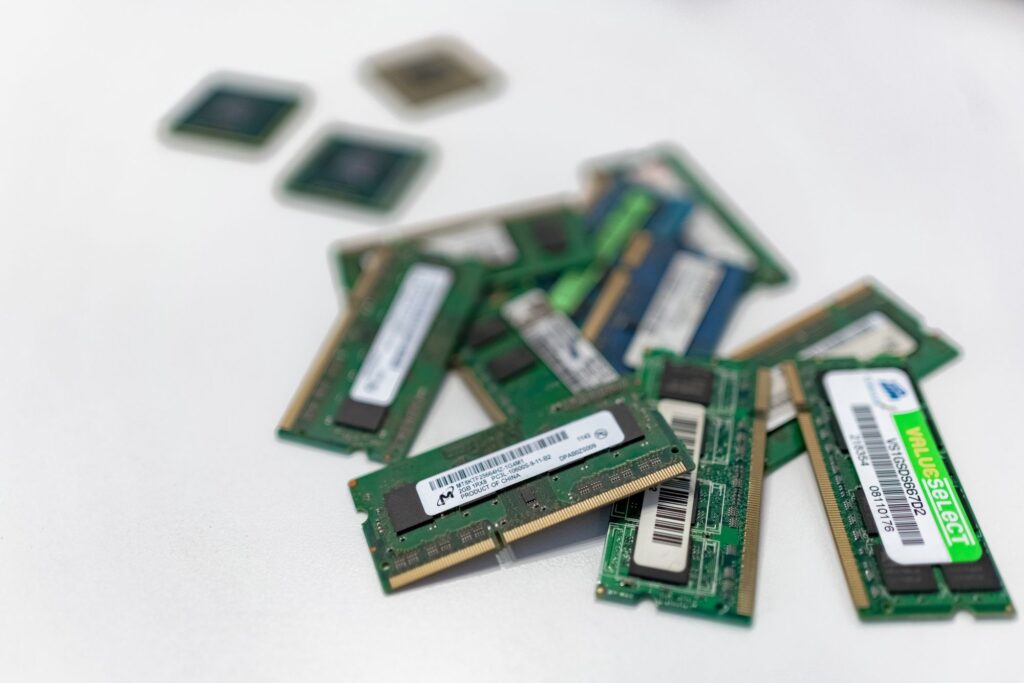
- Check whether the memory is built onto the board or can be replaced later, because that changes what an upgrade costs down the road.
- For an upgrade, match the exact module type and speed your device supports instead of assuming anything labeled “memory” fits.
- Compare the same part across sellers, including shipping and returns.
- Ask whether you need the upgrade now. If your current machine runs fine, the pressure on prices is not a reason to buy.
Frequently asked questions
Are RAM and SSD prices going up or down right now?
According to TrendForce’s September 30 outlook, contract prices were expected to keep rising in the fourth quarter of 2026, by 10% to 15% for conventional DRAM and 15% to 20% for NAND flash. Spot prices in its October 21 update were mixed. Your store’s price depends on many other factors.
Why does AI make my laptop’s memory more expensive?
Because makers have a limited amount of factory capacity and AI servers are the most profitable use of it. TrendForce says suppliers are prioritizing advanced capacity for server products, which can leave less for PCs.
Will prices fall soon?
We cannot say. TrendForce expects tight PC memory supply into 2027, and Micron reportedly expects conditions to be tighter in 2027 and 2028, per TrendForce’s summary of secondary reports. Expectations can change.
Is a laptop with a smaller SSD a worse deal?
Not automatically, but it is a different product. If a model’s price dropped while its storage shrank, you are paying for less, so compare cost per gigabyte of what you actually need.
Before you decide
The market evidence explains why component costs are under pressure. It does not settle whether next month’s sale will beat today’s price, and it is not a signal to rush or to wait. Decide what RAM and storage you really need, compare complete specifications, and check return policies so a purchase can be undone if the details disappoint.
For a business or large order, a professional who handles your purchasing or finances can weigh timing and budget better than a general article. Everything above is dated, so recheck current figures.
Sources
- AI Server Demand Sustains Memory Contract Price Increases in 4Q26, While Consumer-Side Pressure Persists, Says TrendForce (TrendForce, September 30, 2026)
- AI Server Demand Continues to Support Memory Prices in 3Q26, but Gains Moderate as Consumer Demand Weakens and High Base Effects Take Hold, Says TrendForce (TrendForce, July 3, 2026)
- Rapid Contract Price Surge Drives 1Q26 DRAM Industry Up 81% QoQ, Says TrendForce (TrendForce, June 1, 2026)
- [Insights] Memory Spot Price Update: DDR5 Supply Tight, DDR4 Trading Weak Despite 0.84% Gain in Mainstream Prices (TrendForce News, October 21, 2026)
- MICRON TECHNOLOGY, INC. REPORTS RECORD FISCAL FOURTH-QUARTER AND FULL-YEAR 2026 RESULTS (Micron Technology, filed with the U.S. Securities and Exchange Commission, September 30, 2026)
- [News] Micron FY2026 Revenue Surges 256% to $133.2B, Locks In 35%+ of Revenue Through 2030 (TrendForce News, October 1, 2026)
Last updated: November 2026. This article is general information, not financial advice.